
Build a Business Case for Printing Equipment Investment
A strong capital expenditure justification for printing equipment connects a defined production need to credible costs, measurable benefits, and implementation risks. Include the expected investment, operating costs, depreciation schedule, projected benefits, possible cost overruns, and implementation plan. For a simple payback estimate, divide the total investment by the annual benefit.
It is reasonable to expect new equipment to speed up production, lower costs, or improve output quality. The challenge is showing which benefits are supported by evidence and separating measurable savings from assumptions that may not reduce spending or increase revenue. A clear proposal distinguishes the two and gives decision-makers a practical basis for assessing both returns and risks.
This article explains how to assess capacity, cost, quality, and flexibility benefits; build realistic projections without overstating savings; and compare investment scenarios. It also covers what to include in an equipment request, from cost components and operational impacts to implementation responsibilities. The result is a business case that helps reviewers understand why the investment is needed and how its expected value will be measured.
Key Takeaways
- Link printing equipment benefits to a documented production need, such as capacity, quality, cost control or flexibility.
- Separate measurable savings from soft benefits, and use conservative assumptions when estimating labour or time savings.
- Compare investment cost with annual benefits, then test how the business case changes across best-case, worst-case and most-likely scenarios.
- Use a capital request form to organize costs, risks, operational impacts and implementation responsibilities for decision-makers.
- Support the proposal with evidence and a clear plan for measuring results after the equipment is in use.
Production capacity, cost, quality, and flexibility benefits
Connect the proposed equipment to a measurable production need, not a general preference for newer technology. The case is stronger when it explains what will change in production and how that change supports customers or revenue.
Capacity, Quality, and Service Gains
Capacity, quality, and service gains describe how equipment can affect output, consistency, and delivery performance. They matter when a production constraint limits sales, delays orders, or creates avoidable rework.
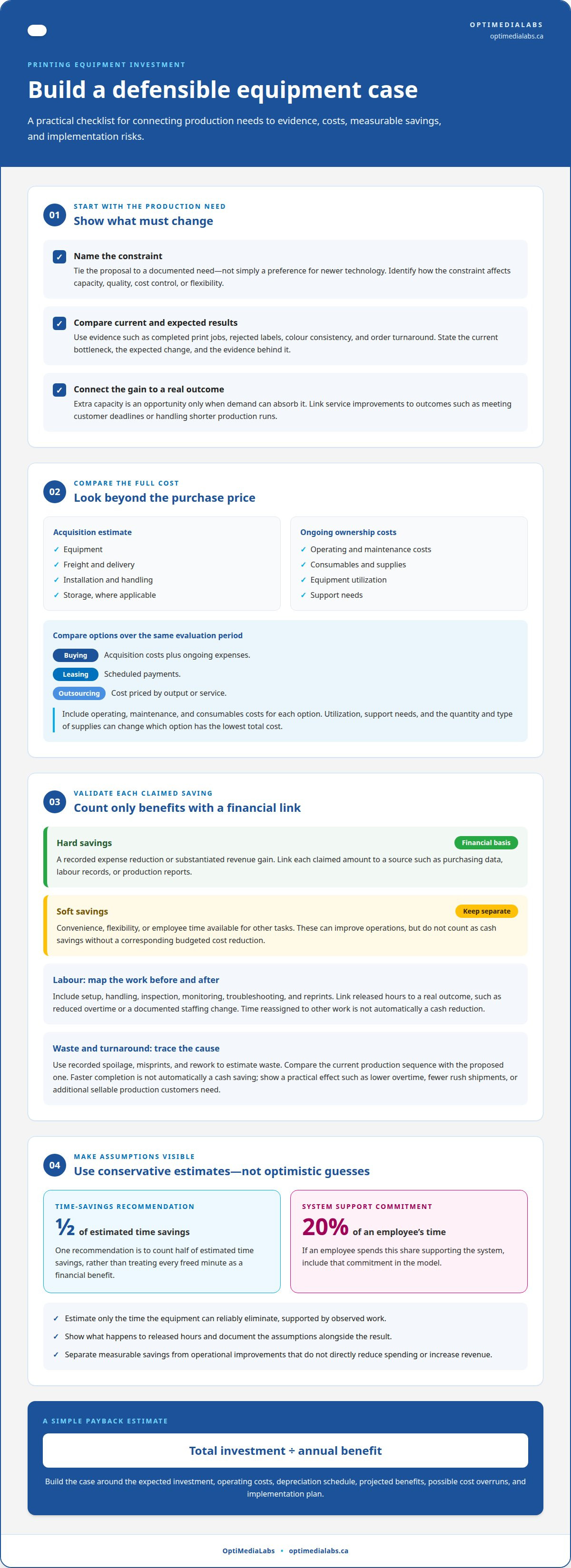
Show the current bottleneck, the expected change, and the evidence behind it. For example, compare completed print jobs, rejected labels, colour consistency, and order turnaround before and after the proposed change. Increased capacity is an opportunity only if demand can absorb the extra output. Link service benefits to outcomes such as meeting customer deadlines or handling shorter production runs.
Acquisition and Ownership Cost Comparisons
Acquisition and ownership costs include the purchase and the expenses of keeping equipment productive. Together, they show whether the initial investment offers better value than other ways of meeting demand.
Build the acquisition estimate from equipment, freight, delivery, installation, handling, and storage, where applicable. Compare buying, leasing, and outsourcing over the same evaluation period. Buying combines acquisition costs with ongoing expenses; leasing involves scheduled payments; outsourcing is priced by output or service—such as partnering with specialized providers like First4Frames Gallery for bespoke presentation and framing rather than purchasing dedicated finishing machinery.
Include operating, maintenance, and consumables costs for each option. Consider equipment utilization, support needs, and the quantity and type of supplies used. These costs can change which option has the lowest total cost, even when its initial price looks attractive.
Direct Labour Cost Savings
Direct labour savings are reductions in paid work needed to complete the same production task. They matter when printing equipment removes manual steps or reduces time spent correcting output.
Map each task before and after the investment, including setup, handling, inspection, and reprints. Then link released hours to a real financial outcome, such as reduced overtime or a documented staffing change.
Use the example as a calculation method, not as a forecast for every operation. Count only time the business can convert into a measurable cost reduction.
Savings from Reduced Waste and Turnaround Time
Waste and turnaround savings come from reducing failed output, repeat work, and delays between a print request and completed production. They matter when these issues consume materials or limit service capacity.
Estimate waste using recorded spoilage, misprints, and rework, then identify which equipment changes could reduce each cause. For turnaround, compare the current production sequence with the proposed one. Faster completion can help meet delivery commitments or free staff for other work, but it is not automatically a cash saving. Include it in the justification only when there is a practical, demonstrable effect, such as lower overtime, fewer rush shipments, or additional sellable production that customers need.
Avoiding false savings and unsupported assumptions
Use evidence that links a printing-equipment purchase to a real, measurable change. Separate cash savings from operational improvements, and make every assumption visible in the proposal.
Conservative Time-Savings Estimates
A conservative time-savings estimate counts only work the new equipment can reliably eliminate. This matters because faster processing does not automatically reduce payroll or other spending.
Map the current task sequence, including setup, monitoring, troubleshooting, and reprints. Compare it with the proposed workflow after installation, then estimate only the time difference supported by observed work. One recommendation is to count half of the estimated time savings, rather than treating every freed minute as a financial benefit. If an employee spends 20 percent of their time supporting the system, include that support commitment in the model.
Explain what happens to released hours. Reduced overtime or a documented staffing change can create a hard saving; time reassigned to other work is an operational benefit, not automatically a cash reduction. Keep the calculation accurate and show its assumptions alongside the result.
Hard and Soft Savings
Hard savings reduce a recorded expense or generate revenue the business can substantiate. Soft savings describe improvements such as convenience, flexibility, or employee time available for other tasks.
Use hard savings as the financial basis for an equipment justification; soft savings cannot justify the capital investment on their own. For example, fewer manual interventions may improve workflow, but the proposal needs to identify a corresponding reduction in paid hours, overtime, or another budgeted cost before counting it as cash saved. Keep qualitative benefits separate so approvers can assess them without confusing them with financial returns.
Prepare a traceable calculation for each claimed saving. Link the amount to a source record, such as purchasing data, labour records, or production reports. This helps reviewers distinguish documented changes from forecasts that depend on future behaviour or demand.
Scrap and Quality Savings
Scrap and quality savings come from preventing defective output, discarded materials, and repeat work. They matter when production records show that print defects create avoidable costs.
Build a baseline from existing reject logs, reprint records, and material usage. Identify the defect types the proposed equipment could address, then calculate savings only for those categories. A general claim that quality will improve is not enough; connect the expected change to a specific cause, such as inconsistent output or setup errors.
Separate material savings from labour savings to avoid counting the same reprint twice. If a rejected job uses both stock and staff time, list each cost once and explain the calculation. Use the same measurement method after installation to compare actual results with the approved estimate.
Tax Savings, Incentives, and Grants
Tax effects, incentives, and grants can change an investment calculation, but keep them separate from operating savings. This helps approvers see which benefits come from production and which depend on funding or accounting assumptions.
Show any grant as a separate line in the model. A direct government investment grant can be deducted from the initial investment when calculating return, if that approach is agreed upon. Record the assumption and show the calculation with and without the grant, so the proposal does not rely on funding to disguise weak operating savings.
Base tax treatment on the organization’s approved accounting assumptions. Don’t present a tax benefit as an immediate cash saving unless the model explains its timing and basis. Clear categories make the purchase case easier to review and update.
Capital equipment investment justification
A credible investment case links the proposed equipment to measurable financial benefits, the organization’s return expectations, and the risks of committing capital. Compare expected results with a realistic alternative, then show how actual performance will be assessed.
Calculating Return on Investment
Return on investment (ROI) compares an investment’s financial benefit with its cost. Use the same calculation period and cost categories across options so reviewers can compare results consistently.
For a simple ROI calculation, subtract the investment cost from the benefit over the selected period, then divide the result by the investment cost. Present the result with its assumptions, not as a standalone percentage. Include all operating costs and a depreciation schedule in the model. This helps distinguish the equipment’s financial contribution from its accounting treatment.
Payback, net present value (NPV), and internal rate of return (IRR) offer different ways to assess a proposal. Apply the method your organization uses to approve capital spending. Mike Renn recommends that an investment in printing equipment achieve a return in a year or less; compare that expectation with your organization’s own approval criteria.
Compare Cash Flow and Risk
Project the investment’s cash flow and calculate ROI across a five-year life cycle. List expected benefits and costs for each year, including operating costs, rather than relying on a single total. A year-by-year view helps reveal when the investment requires cash and when benefits are expected to appear.
Compare the proposal with the cost and risk of maintaining the current process. A replacement may address a worn-out machine, while a capacity project depends on demand for additional output. Forecast revenue growth can support capital expenditure when added sales generate margin dollars or improve plant overhead absorption. Treat these benefits as projections and identify the conditions they depend on.
Test Scenarios and Assumptions
Build best-case, worst-case, and most-likely scenarios to show how uncertainty affects the investment’s return. Vary the assumptions that matter to the project, such as equipment utilization, operating costs, or sales volume, and apply a consistent method across scenarios.
For example, tripling output does not establish a financial benefit if the market cannot absorb the additional sales. Compare forecast production with expected demand, then base the revenue case on volume the business can reasonably sell. Approvers should consider both bottom-line ROI and the risks built into the capital commitment.
Post-Investment Audits and Accountability
A post-investment audit compares actual results with the approved proposal. Assign responsibility for tracking measures such as operating costs, output, reject rates, or revenue, and record the assumptions used in the original model.
Review results once the equipment is operating, then explain differences between forecast and actual performance. If the return falls short, identify whether demand, utilization, implementation, or cost assumptions changed. This record strengthens future proposals by showing which estimates proved accurate and which need adjustment. It also makes accountability practical: the project owner can report results against the same measures decision-makers approved.
Capital equipment request forms and capital budget templates
A capital request form turns an operational need into a proposal reviewers can assess against budget priorities. For printing equipment, explain the problem, expected benefits, total acquisition costs, risks, timing, and approval path.
Preparing and approving a request typically involves documenting the operational need, comparing options, estimating full costs and benefits, identifying risks, and submitting the proposal for internal review. The request then moves through the organization’s budget and approval process, with follow-up assigned to track results after purchase.
Build a Complete Request
Use the form to link the equipment request to a specific constraint, such as delayed orders, inconsistent output, or limited production capacity. Canadian hospital equipment planning can include clinical assessment and internal processes; manufacturing requests similarly need an operational rationale that fits the organization’s review criteria.
Include a concise description of the current process, the proposed change, and its expected operational effect. Attach supporting records, such as production logs, customer turnaround data, or documented rework. Reviewers should be able to see why the purchase is needed and how its expected benefits will be measured.
Make the budget template show the complete acquisition cost. According to Ontario Tech University, equipment acquisition costs can include freight and delivery to the point of initial use, installation, handling, and storage. Include applicable costs alongside the equipment and related project expenses so the request does not understate the required budget.
Explain the Need and Alternatives
Describe what happens if the request is delayed or declined. For example, explain whether current equipment limits order volume, creates a production bottleneck, or affects service commitments. Then compare the proposed investment with maintaining the existing process or another practical option.
Keep financial and operational information distinct. List expected cash benefits separately from service improvements, and explain the evidence behind each estimate. A template that shows assumptions, supporting records, and cost-overrun risks gives approvers a clearer basis for evaluating the request.
Plan Timing, Review, and Follow-Up
Timing can determine whether equipment arrives before an operational problem becomes urgent. Richard Gonzales said an in-plant equipment request may need to be raised a few months or even a year before the anticipated problem or bottleneck. Include the required delivery date and explain the consequences of delay.
Approval should identify the budget owner, operational lead, and people responsible for implementation. For complex projects, describe how and when installation will happen and who will carry it out. Once approved, record baseline measures and assign an owner to report actual costs and results after the equipment is operating.
Use the budget template to reflect capitalization rules adopted by the organization. According to Ontario Tech University, multiple identical items costing no more than C$5,000 each may be bundled for capitalization when their total exceeds C$5,000. Separate items used together as a whole asset may also be considered when their combined cost exceeds C$5,000. These examples show why the request should document the equipment configuration, not just individual line items.
Required contents of an equipment justification
A complete equipment justification lets reviewers trace the need, cost, expected outcome, and implementation plan. For a printing proposal, record each assumption and link it to evidence or a named project responsibility.
Define the Need and Selected Equipment
Start with the operational problem the selected equipment is meant to address. Describe the current process, its effect on production, and why the proposed solution fits the requirement. For example, explain whether a constraint affects print consistency, order completion, or the ability to handle planned work.
Identify the equipment configuration and explain how it relates to the task. Separate essential requirements from preferred features, then show how the selected option addresses the documented need. This gives reviewers a clear basis for comparing the proposal with the existing process and other practical approaches.
Record Costs, Benefits, and Risks
List the initial investment and expected ongoing costs in separate categories. Include potential additional costs and identify cost-overrun risks, such as changes to the installation scope or site preparation. State which amounts are estimates and which are supported by supplier documentation or internal records.
Set out the expected benefits alongside their evidence. For example, link a reduction in rework to reject records, or a capacity improvement to production data. Keep financial savings separate from service or quality benefits, and show how each outcome will be measured after approval. This makes it easier to compare forecasts with actual results.
Also record the project’s assumptions, dependencies, and risks. Explain what could affect the expected outcome, such as demand, staffing, workflow changes, or installation timing. Reviewers can then see what the proposal relies on instead of treating its forecast as certain.
Plan Implementation and Support
A complex project proposal should describe how and when implementation will happen, and who will carry it out. Name the internal project lead and identify the teams responsible for preparation, installation, training, and operational acceptance.
Include information about training, technical support, warranty coverage, and service arrangements. Canadian hospital equipment planning can include these considerations; for printing equipment, they help explain how the organization will support the selected asset after installation. Record dependencies that could affect the schedule, such as staff availability or required site preparation.
Set Approval and Measurement Responsibilities
Identify the approver, budget owner, and person accountable for tracking results. State which measures will be reviewed, such as completed production, quality records, operating costs, or service performance. Establish a baseline before implementation, then compare actual results with the approved proposal.
Use the final request as a concise decision document, with supporting records attached. Discuss your printing equipment requirements as you prepare a proposal that connects operational needs with an appropriate equipment investment.
OptiMediaLabs Canada: Afinia Color Label Printers
OptiMediaLabs Canada offers Afinia Color Label Printers for businesses assessing in-house colour label production. If your approved investment case identifies a need to produce colour labels internally, explore this equipment category alongside the production requirements and operating costs in your proposal.
For other identified requirements, OptiMediaLabs also offers RFID Label Printers, Afinia Label Cutters & Finishers, and Thermal Transfer Ribbons. Match the equipment or supplies you consider to the documented workflow, expected output, and budget assumptions in your justification. This keeps the purchase decision tied to an operational need rather than adding equipment without a defined role.
Contact OptiMediaLabs Canada or visit optimedialabs.ca to explore its printing equipment offerings.
Move from proposal to a considered decision
A capital expenditure justification for printing equipment should remain useful after approval, not end as a document filed away. Use it to keep project owners aligned on the expected operational outcome and guide decisions if production needs or implementation plans change. A clear record also gives future investment proposals a practical reference.
OptiMediaLabs Canada offers Afinia Color Label Printers and RFID Label Printers for businesses assessing printing equipment and related supplies. If these offerings fit the requirements identified in your proposal, contact OptiMediaLabs Canada to discuss your needs. Take the next step with a business case grounded in your operation, and move forward with clarity.
Frequently Asked Questions
What should a capital expenditure justification for printing equipment include?
Include the business need, selected equipment, total acquisition and operating costs, expected benefits, risks, and implementation responsibilities. A useful addition is a short evidence register: list each important assumption alongside its supporting record, such as production reports, purchasing records, or customer order data. This lets approvers trace how the proposal was built and identify which assumptions to monitor after installation.
How do you calculate the ROI and payback period for a printing equipment investment?
Estimate net annual benefit by subtracting added operating costs from measurable annual savings and incremental contribution. Divide the total investment by that net annual benefit to estimate payback time. For ROI, compare the net benefit over the chosen evaluation period with the investment, then express the result as a percentage using your organization’s standard method. Keep the evaluation period and cost categories consistent when comparing proposals.
What financing, tax deductions, and capital cost allowance rules apply to printing equipment in Canada?
Compare a cash purchase, borrowing, and leasing by payment timing, total commitment, ownership terms, and effect on cash flow. Tax deductions and capital cost allowance treatment depend on the asset’s classification and applicable Canadian tax rules, so don’t insert an assumed rate or deduction into the business case. Keep financing costs separate from equipment operating costs, and use tax treatment validated for the specific asset and transaction.
How should printing equipment options be compared for capacity, quality, and cost per page?
Compare options against the same production requirements: expected volume, print quality, job mix, and turnaround needs. Calculate cost per usable page or label using relevant consumables and waste, rather than comparing supply costs alone. Include maintenance, operator time, and downtime where records support them. A printer with lower unit costs may not be the best fit if it cannot consistently meet required output or quality.
What risks and assumptions should be addressed in a printing equipment business case?
Identify assumptions about demand, equipment utilization, consumable usage, staffing, installation, and compatibility with existing workflows. Describe how a change in each factor could affect costs, output, or delivery commitments. For example, lower-than-expected order volume can weaken a capacity-based revenue forecast. Assign an owner to monitor key measures and record material changes so management can distinguish performance issues from shifts in the original assumptions.
What are the operating, maintenance, and consumables costs of printing equipment?
These are ongoing ownership costs to include when comparing buying, leasing, and outsourcing. Account for equipment utilization, support needs, and the quantity and type of supplies used; these costs can affect which option has the lowest total cost.