
Frozen Food Label Material: Choose a Stock That Sticks
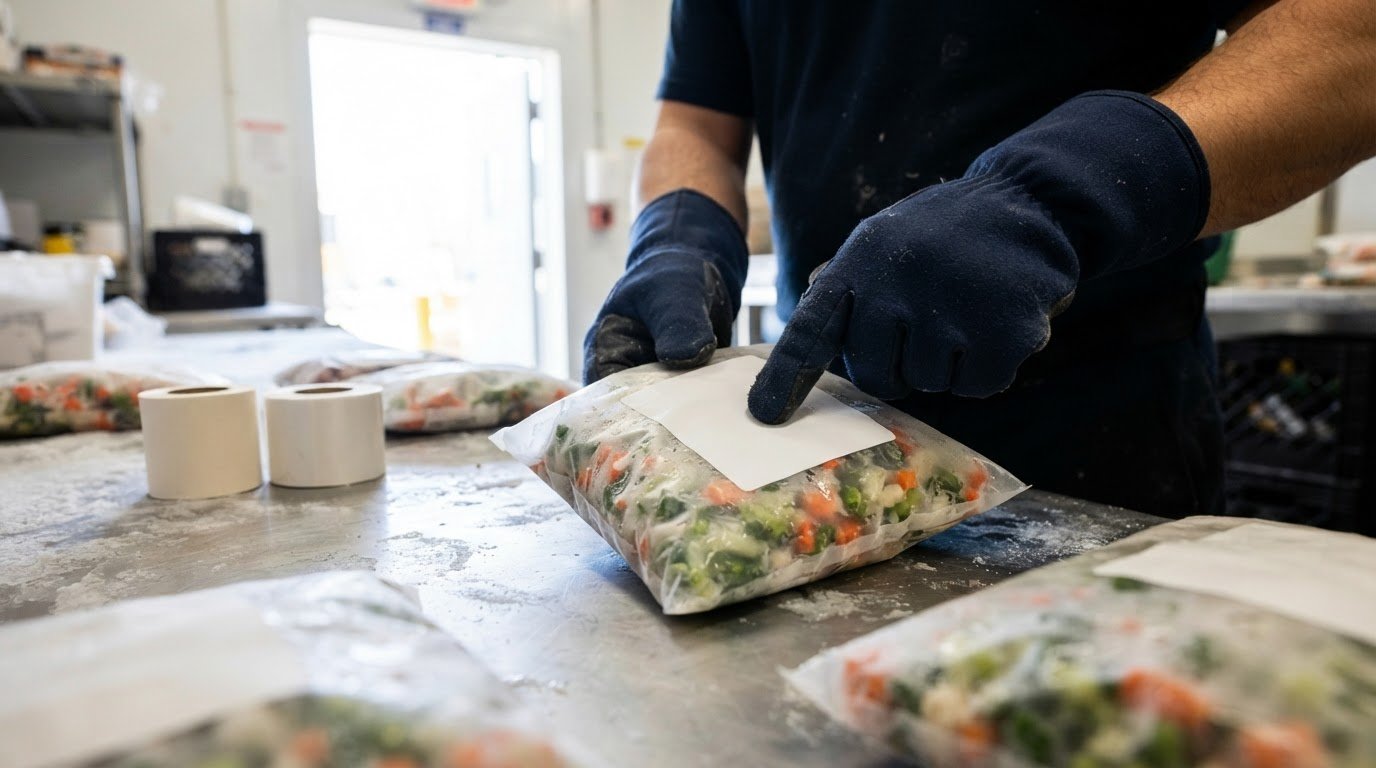
The best label material for frozen food packaging depends on more than freezer temperature. Coated freezer paper is listed for use down to -20 °F, white polypropylene down to -65 °F, and polyester down to -112 °F. The adhesive and package surface matter just as much.
Even the best label material for frozen food packaging can fail if its adhesive isn’t suited to the application surface and temperature. A label that looks suitable on a roll may lift from a cold, damp pouch or curved container.
This guide explains how facestock, adhesive and packaging surfaces affect label performance. You’ll learn where paper, polypropylene and polyester fit, and how application, storage and distribution conditions shape stock selection. Use these factors to choose the best label material for frozen food packaging.
Key Takeaways
- Match the facestock to the coldest conditions the label will encounter, including application, storage and distribution.
- Choose a freezer-grade adhesive suited to the package surface and any moisture or condensation it may face.
- Use moisture-resistant synthetic facestocks for exposed packaging; coated paper may suit protected applications.
- Consider how the label material and packaging shape work together, especially on pouches, curved containers and transparent packs.
- Explore Labelview software alongside label-printing equipment when you’re planning how to produce labels for frozen products.
What is the best label stock for frozen food packaging?
The right stock depends on the coldest conditions, package surface and application timing. For freezer use, match both the facestock and adhesive to the package’s full journey through the cold chain.
Cold-Chain Material Selection
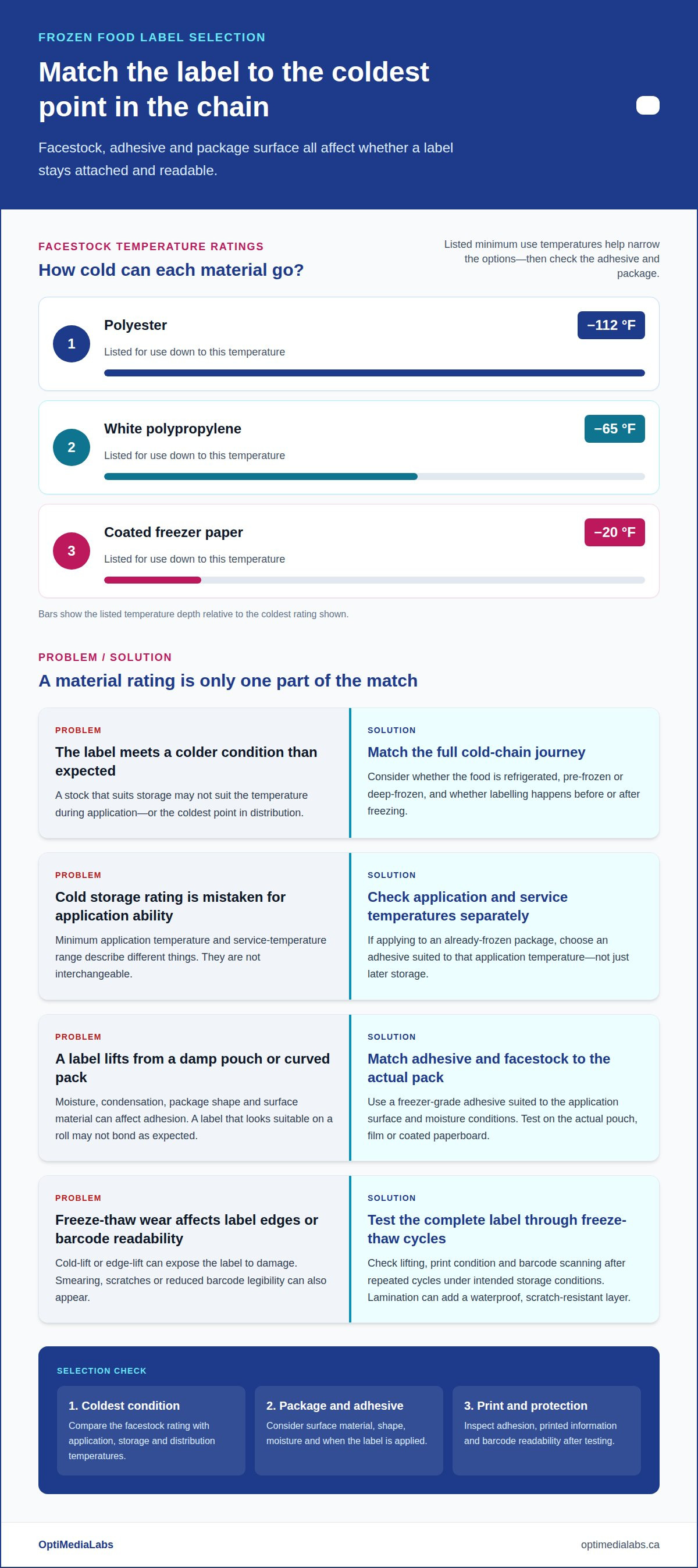
Cold-chain material selection means matching label stock to temperatures during application, storage and distribution. Decide whether the food is refrigerated, pre-frozen or deep-frozen, then consider whether packaging is labelled before or after freezing. Coated freezer paper is listed for use down to -20 °F, white polypropylene down to -65 °F, and polyester down to -112 °F. These ratings help narrow options, but materials can react differently at different freezing temperatures.
Minimum application temperature is the lowest temperature at which a label can be applied and expected to stick. The service-temperature range describes the temperatures a label can withstand. These measures aren’t interchangeable. A label applied to a frozen package needs an adhesive suited to that application temperature, not just to later storage conditions.
Barcode Durability Through Freeze-Thaw Cycles
Barcode durability means the printed code stays attached, legible and scannable through temperature changes. Cold-lift occurs when a label loses adhesion on a cold surface; edge-lift begins around its perimeter, often where moisture or condensation reaches the adhesive. Both can expose the label to further damage and make the barcode harder to read.
Test label samples through several freeze-thaw cycles on the actual package and under the intended storage conditions. After each cycle, check for lifting, smearing, scratches and reduced barcode legibility. Lamination can add a waterproof, scratch-resistant layer. Test the complete label, including the print and protective layer, rather than judging the facestock alone.
Freezer-Grade Adhesives for Paper Labels
Freezer-grade adhesive is formulated to maintain adhesion in cold conditions, including on already-frozen surfaces. Paper labels can work for frozen goods with a suitable freezer adhesive, but exposed paper isn’t waterproof. Use paper for dry frozen goods or inner wraps protected by an outer layer.
Frozen status doesn’t remove the need for basic food-label information in Canada. The exact requirements depend on the product and package; selecting a stock doesn’t establish compliance. Costs also vary with factors such as facestock, adhesive, label format and print requirements, so no single material price applies to every use.
Adhesion, Durability, and Legibility Testing
Testing checks whether a label stays attached and readable across the conditions it will encounter. Compare application before freezing with application to an already-frozen package, using the intended adhesive for each surface and temperature. Freezer-grade adhesives should maintain stickiness at -20 °C or colder; some can be applied as low as -15 °F and hold across roughly -65 to 120 °F.
Test the actual packaging material, whether it’s a pouch, film or coated paperboard. Check for cold-lift and edge-lift, then review printed information and scan the barcode after repeated freeze-thaw cycles. The stock’s temperature range, adhesive performance and surface compatibility together determine whether it suits the application.
Adhesive suitability for indirect food contact
For frozen-food labels, adhesive suitability depends on the package surface, application conditions and intended food-contact relationship. Consider migration, moisture and print performance together, rather than choosing an adhesive based on temperature alone.
In Canada, a label intended for indirect food contact isn’t automatically suitable for direct food contact. For products such as meat, fish or ice cream, consider whether fat-soluble adhesive components could migrate into the food. Choose materials for their intended use and keep the label on the package exterior unless its components are suitable for direct exposure.
Adhesion on Cold, Damp Surfaces
Adhesion on cold, damp surfaces is the adhesive’s ability to bond despite low temperatures, ice or condensation. Strong initial tack matters because moisture can interfere when a label meets a chilled pouch or container.
Standard label adhesives may crystallize and harden between 40 and 50 degrees Fahrenheit, preventing a reliable bond. Tell the label supplier if the package surface is icy or condensation-damp, rather than clean, smooth and dry. A freezer-grade adhesive with strong initial tack can help resist edge-lifting as condensation forms.
Low-Temperature Adhesive Tack
Low-temperature tack describes how readily an adhesive grabs a surface in cold conditions. General-purpose acrylic adhesive can lose tack below about +5 °C, so an adhesive suited to room-temperature application may not work on chilled packaging.
Match the adhesive to temperatures before, during and after application. A label applied to a cold package, for example, needs different application capability from one applied warm and then frozen. Freezer-grade adhesives are designed to retain their stickiness at low temperatures, including on already-frozen surfaces.
Ink must also stay bonded to the facestock in cool, harsh conditions, particularly on plastic packaging. Choose a printing system and ink suited to the actual label material. Thermal-transfer printing uses wax ribbons with paper facestocks, while wax-resin or resin ribbons suit synthetic films. Flexographic printing supports different inks and substrates, with rapid printing and drying.
Lamination adds a waterproof, scratch-resistant layer that can protect information on the finished label. It doesn’t replace suitable adhesive or ink. Test the complete combination on the intended package, including any finish, and inspect the print after cold storage and handling.
To align label materials and printing requirements for a frozen product, discuss your label-printing needs with the team.
Coated paper, polypropylene, and polyester facestocks
Facestock is a label’s printable outer layer. For frozen-food packaging, choose it based on moisture exposure, package shape and whether an outer wrapping protects the label. Coated paper, polypropylene and polyester suit different conditions, so choose material for the package rather than the product category alone.
Coated Paper for Protected Applications
Coated paper provides a paper-based printing surface, but exposed paper can absorb moisture and lose strength. Freezer-grade adhesive helps the label attach in cold conditions; it doesn’t make the paper waterproof. For example, paper may suit a dry frozen product’s inner wrap when an outer package shields it from condensation and handling.
Avoid coated paper on moisture-prone surfaces where the label is directly exposed. A frozen-food pouch moving through storage and distribution can collect condensation, which may soften paper and affect printed information. Paper is practical when the label stays protected, not as the default for every freezer application.
Polypropylene for Moisture-Prone Packages
Polypropylene is a plastic-film facestock. Its moisture resistance makes it useful on exposed frozen-food packaging, where paper can absorb water. The flexible film can also conform to packaging such as a curved container or a pouch that bends during handling.
Consider how the package moves. A flexible pouch may crease during filling, stacking or handling, so the label must suit both the surface and how it changes shape. Polypropylene may fit these conditions better than paper, but the adhesive still needs to match application and storage conditions.
Polyester for Demanding Freezer Conditions
Polyester is another synthetic-film facestock used for freezer labels. Its stated low-temperature use makes it an option for products facing especially cold storage conditions. It may also suit applications where the label needs a more durable film face than paper provides.
Use the label’s stated temperature range to assess whether polyester fits the product’s journey. A facestock rating alone doesn’t confirm that the adhesive, ink or finish will perform equally well. For a package moving between frozen storage and handling areas, assess the complete label construction, not polyester in isolation.
Plastic-Coated Paperboard
Frozen-food paperboard packaging may have a thin plastic layer to improve moisture resistance. That coating changes the label surface: the adhesive contacts plastic rather than untreated paperboard. Pressure-sensitive labels generally adhere best to clean, smooth, dry, non-porous surfaces, so dirt or condensation can interfere with bonding.
A frozen-food carton, for example, may have coated areas and exposed edges. Position the label on the coated surface and match the adhesive to that finish. This distinction helps avoid treating paperboard cartons and paper labels as the same material. A carton’s protective coating doesn’t make an exposed paper facestock waterproof.
BOPP labels for frozen foods
BOPP, or biaxially oriented polypropylene, is a film facestock described as waterproof and oil-resistant for cold-storage food packaging. Those properties matter when a frozen product’s label may encounter moisture or oily residue. A frozen meal pouch, for instance, can collect condensation during handling, and the package may carry traces of food oils. BOPP can address these exposures, but the complete label still needs a compatible adhesive and print system.
Start with the package surface and label position. A BOPP label on a pouch, carton or container needs an adhesive suited to that surface and the application conditions. Clean, smooth, dry and non-porous surfaces generally support pressure-sensitive adhesion. If condensation or ice is present during application, the adhesive needs suitable initial tack. A waterproof facestock can’t compensate for a poor bond underneath.
Printing matters too. Printed information must stay clear through cold storage and handling, so assess ink adhesion on the chosen film. For thermal-transfer printing, wax-resin or resin ribbons are identified for synthetic films, while wax is used with paper. This distinction helps match the ribbon to BOPP’s plastic facestock and avoid choosing one intended for another label material.
Consider the finish too. A coating or laminate changes the label’s outer surface and can affect its interaction with moisture, abrasion and printing. Lamination adds a waterproof, scratch-resistant layer to refrigerated and frozen-food labels. Test the finished construction, including BOPP, adhesive, ink and any protective layer, rather than judging the film alone. This is especially relevant when labels undergo repeated handling or freeze-thaw cycles.
Clear BOPP offers another option: on a transparent container, it can create a “no-label” look. The choice depends on package design and where printed information sits. A clear label may blend with the container, while white BOPP provides a more visible background. Either option still needs legible printing and an adhesive suited to the container’s surface.
Choose BOPP when its waterproof and oil-resistant properties suit the package conditions, not as a universal freezer stock. Compare it with coated paper for protected wrapping and with other synthetic films for demanding storage conditions. Then test a printed sample on the actual package. After cold exposure, check adhesion, print clarity, barcode scanning and surface wear. This comparison shows whether BOPP’s film face, adhesive and print finish work together for the product’s handling path.
Choosing labels based on packaging surface
The packaging surface affects how a pressure-sensitive label bonds and stays in place. Identify the material, shape and finish where the label will sit. A flexible pouch, clear container and metal package each present different application needs. Then match the facestock and adhesive to the surface and the conditions it encounters in cold storage.
Surface condition matters as much as material. Pressure-sensitive labels adhere better to clean, smooth, dry and non-porous surfaces. Oil, frost, condensation or roughness can interfere with adhesive contact. For example, a pouch taken from a cold room may have condensation where the label goes. A permanent freezer adhesive must suit both the packaging material and application conditions.
Use the package type to narrow the material choice:
- Flexible pouches and squeeze bottles: Polyethylene labels are flexible and moisture-resistant. They can adapt to curved surfaces and pouch shapes.
- Transparent containers: Clear BOPP can create a “no-label” look while keeping printed information visible.
- Metal, glass, aluminium or tin: These surfaces typically need no special ink, coating or label modifications, as they act as an absolute barrier.
On a curved pouch, flexibility helps the label follow the package instead of bridging a bend. That fit matters around seams and changing contours, where label edges can catch during handling. A squeeze bottle also flexes as its contents are used. Choose a label and adhesive suited to both the surface and its movement, rather than treating the bottle as rigid.
Transparent packaging calls for a different decision. Clear BOPP can reduce visual contrast between the label and container, while an opaque label creates a distinct printed panel. Consider label placement and whether the package contents need to remain visible. A clear label still needs readable print, and its adhesive must bond to the container under the intended storage conditions.
Metal, glass, aluminium and tin provide barrier surfaces, but cleanliness still affects pressure-sensitive adhesion. A smooth glass container with condensation differs from a dry glass surface at application. Similarly, residue on a metal package can prevent the adhesive from making proper contact. Surface material alone can’t replace suitable application conditions.
Match the permanent adhesive to the packaging material and the label’s temperature journey. For labels applied to curved or flexible packs, test samples on the actual package and inspect the edges after handling. Discuss label and packaging compatibility to align the right stock with your application.
OptiMediaLabs Canada: Labelview software
OptiMediaLabs Canada offers advanced design software for businesses planning label production after selecting suitable frozen-food stock. It is a relevant next step when you are aligning label materials with a reliable printing workflow. Professional colour label printers can also support vibrant label production, while specialised equipment and finishing systems address other parts of label operations.
Consider these offerings when your packaging requirements are defined and you are deciding how to produce or finish labels. The right setup depends on the label task and production needs. For guidance on software and equipment options, contact OptiMediaLabs Canada.
Turn your label choice into a production plan
Make the next step a clear production specification. Record the package surface, application conditions, storage range, facestock, adhesive and print requirements together. This gives your team a consistent basis for evaluating label materials as packaging or production needs change. The best label material for frozen food packaging is the one that fits the package and the full workflow, not just the freezer.
OptiMediaLabs Canada offers Afinia Color Label Printers, Epson Ink Cartridges and RFID Label Printers for label production and identification needs. Choose equipment and supplies that fit your planned process, then align them with the label construction you’ve selected.
Contact OptiMediaLabs Canada to discuss labels and take the next step towards a well-matched label workflow.
Frequently Asked Questions
Can you apply a label to an already frozen product?
Yes, if the adhesive is designed for application at the product’s surface temperature. A label applied to a frozen meal carton, for example, needs an adhesive suited to that cold application, not just to freezer storage afterwards. Ice or condensation at the application point can affect the bond. Match the adhesive’s application rating to the actual surface conditions, then assess the finished label on the package.
Need Help Finding the Right Label for Your Product?
OptiMediaLabs Canada can help you connect your label-production requirements with suitable printing hardware, supplies and software. Start with the packaging format, the label material you plan to use, and whether your production needs colour or barcode output. These details help frame the equipment discussion around your workflow. For support with label-printing products, contact OptiMediaLabs Canada.
What About Adhesives?
Choose an adhesive for the package surface, application temperature and food-contact relationship. A permanent freezer adhesive is intended to stay bonded, but “permanent” alone doesn’t mean it suits every frozen package. An adhesive that works on a dry carton, for example, may behave differently on a flexible pouch. For products such as meat or ice cream, consider whether adhesive components could migrate into food.
How do BOPP, PET, vinyl, and paper labels compare for frozen food?
BOPP is a polypropylene film described as waterproof and oil-resistant, while PET is polyester, a synthetic facestock suited to very cold conditions. Vinyl is described as durable and resistant to temperature swings for heavy-duty freezer use. Paper is generally better protected from moisture, such as on an inner wrap beneath an outer package. Compare exposure and flexibility needs, not material names alone.
Which label adhesives work on cold, wet, or frosty packaging?
Freezer-grade adhesives with strong initial tack suit cold applications, including surfaces affected by condensation. Frost, water or oils can make bonding harder, so the adhesive must match both the package surface and application conditions. A damp plastic pouch, for instance, needs a different evaluation from a dry paperboard carton. Permanent freezer adhesives should also suit the packaging material.
Are freezer labels suitable for application before or after freezing?
Labels can be applied before freezing or to an already-frozen surface if the adhesive matches the application conditions. A label applied before freezing bonds under the initial surface conditions, then experiences the temperature drop. Applied afterwards, it must make contact at freezer temperatures. If a product is labelled at different points in production, assess each application scenario separately using the actual package and label construction.
How do condensation and moisture affect frozen food label adhesion and print quality?
Condensation can weaken the bond at a label’s edges and cause lifting, while moisture may damage exposed paper. Water-resistant film facestocks and protective laminate can help protect the label surface. Print durability also depends on ink adhesion to the facestock, particularly with plastic films. After cold storage and handling, inspect printed details and scan barcodes to confirm they remain clear and usable.