
How RFID Labels Improve Supply Chain Visibility and Inventory Accuracy

RFID changes the inventory question from “Can someone scan this item?” to “Where is the tagged stock moving?” Improving supply chain visibility with RFID labels means using radio waves to identify multiple tagged items without scanning each one in direct line of sight. That can make it easier to monitor goods as they move through warehouses, distribution centres and other supply chain locations.
Barcodes remain useful when workers need to scan a specific item directly. RFID offers a different approach: readers can capture data from several tags at once, including as items move through a facility. The right choice depends on how you handle inventory, the level of detail you need and how the data will support daily operations.
This article explains how RFID labels work in supply chains and where they can improve inventory accuracy and shipment visibility. You’ll learn how RFID data connects with ERP and warehouse management systems, what shapes implementation costs, and how RFID compares with barcode scanning. Use these points to decide which approach fits your operation.
Key Takeaways
- Understand how RFID labels and readers record inventory movement across supply chain locations, including during omnichannel fulfilment.
- See how more timely inventory data can help teams spot discrepancies, anticipate replenishment needs and verify shipments.
- Assess implementation costs by considering the tags, readers, software and integration required for your operation.
- Learn how RFID data can work with ERP and warehouse management systems to support coordinated decisions.
- Compare RFID’s ability to read multiple items without direct line of sight with barcode scanning’s item-by-item approach.
What Is RFID in Supply Chain Management?
RFID uses radio signals to identify tagged goods as they move through supply chain processes. For Canadian businesses, it can make inventory movement visible across facilities, shipments and sales channels.
Real-Time Inventory and Shipment Tracking
RFID readers capture tag data as inventory, shipments or assets pass through a location, supporting real-time tracking. This visibility helps teams see whether stock has arrived, moved or remains available for an order.
For omnichannel fulfilment, item-level records can help staff check whether a product is in a stockroom or ready for an online order. Before dispatch, a worker can scan an order to verify the selected items, quantity, destination, packaging and documentation. These checks link inventory management to fulfilment and can help catch errors before an order leaves the facility.
RFID can also track goods from raw materials through manufacturing and delivery. As a tagged pallet moves between a warehouse and loading dock, it generates movement data that teams can use to see where inventory is in the process. When goods are transferred to over-the-road freight carriers like Pulse Express, dockside scans help verify shipments as they leave the facility. The value depends on readers capturing tag data and software turning those events into useful information.
RFID Labels and Tags
An RFID smart label combines a printed label with an inlay containing a microchip and antenna. The chip stores identifying information, such as an Electronic Product Code (EPC), and the antenna responds to a reader’s signal.
Supply chains use passive RFID for general inventory tracking, semi-passive tags for condition monitoring, and NFC RFID for short-range consumer interaction. Tags can be attached at item, case or pallet level, depending on the tracking detail required. Item-level tags, for example, can distinguish products in a retail order, while a pallet tag identifies a larger shipment unit.
Choosing the tag level shapes what inventory data can show. Item identifiers support detailed order checks; case and pallet identifiers help teams follow grouped goods between facilities. Printed information remains useful for people handling the goods. Printed label formats can present human-readable details alongside machine-readable identification.
For Canadian supply-chain tracking, GS1 EPC global standards provide a framework for uniquely identifying items. They address identification, while the applicable requirements for a deployment depend on its use and the data it collects.
Privacy and security need attention when RFID records connect to employees. The Office of the Privacy Commissioner of Canada notes that systems containing employee personal information may be compromised. Limit personal data in tag records, control access to linked systems and define how RFID data is retained and used.
Warehouse visibility and inventory accuracy
In a warehouse, RFID links item identities with recorded movements and stock levels. Teams can compare system records with physical inventory, find discrepancies and decide which locations need attention.
Inventory accuracy affects replenishment and order fulfilment. If the system shows stock that isn’t on the shelf, a retailer may promise an unavailable item. If stock is present but unrecorded, staff may miss a sale. RFID can capture inventory data during routine movement, helping teams spot differences sooner than counts performed only at intervals.
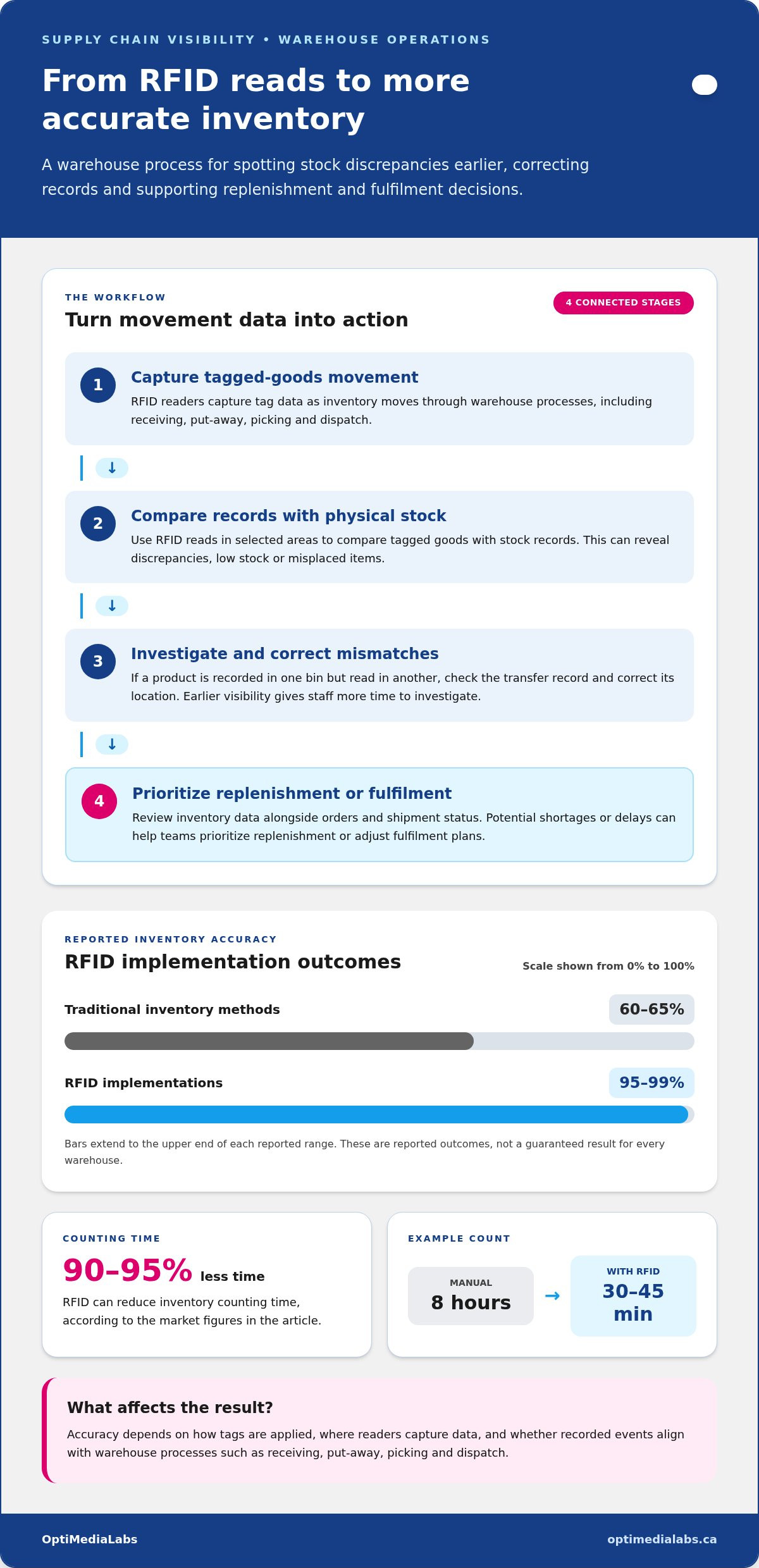
RFID implementations can raise inventory accuracy to 95-99%, compared with traditional inventory methods averaging 60-65%. These figures describe reported implementation outcomes, not a guaranteed result for every warehouse. Accuracy depends on how tags are applied, where readers capture data, and whether recorded events align with receiving, put-away, picking and dispatch processes.
Automated tracking can also make cycle counting more efficient. Instead of pausing operations for a full manual count, a warehouse can use RFID reads to compare stock records with tagged goods in selected areas. RFID reduces inventory counting time by 90-95%, according to the market figures in this article. A count that takes 8 hours manually can take 30-45 minutes with RFID.
Earlier visibility gives staff more time to investigate mismatches. For example, a cycle count may show a product recorded in one bin but read in another. The team can check the transfer record, correct the location and improve the accuracy of inventory data. Counts can also reveal low stock, misplaced goods and items that need replenishment.
Warehouse data becomes more useful when managers review it alongside orders and shipment status. RFID information can flag potential shortages or delayed shipments, helping teams prioritize replenishment or adjust fulfilment plans. If an online order needs an item with a stock discrepancy, for example, staff can search for it before cancelling the order.
Start with the inventory problem that causes the most operational friction, such as missing items during picking or unreliable counts in a high-turnover zone. Then assess how tags and reader placement fit the warehouse workflow. If you’re evaluating RFID for inventory tracking, you can discuss your warehouse requirements with the team.
RFID implementation costs and business value
RFID investment involves more than tags. A business may need labels, readers, printing equipment, software and connections to existing systems. Costs depend on the number of tracking points, whether readers are handheld or fixed, and how much workflow automation is needed. A single pallet checkpoint has different requirements from item-level tracking across manufacturing, warehousing and dispatch.
Business value comes from comparing those requirements with operational gains. Typical payback periods for RFID implementations are 12-18 months. The return calculation should reflect the work RFID changes: manual counts, shipment verification, stock searches and corrections to inventory records. For example, a distributor can assess whether automated pallet identification reduces repeated checks at receiving and dispatch.
Direct-to-consumer brands can focus on the points where inventory accuracy has the greatest effect on orders. A brand shipping from a warehouse and retail locations can use RFID events to improve stock records for fulfilment. Start by mapping how products move from manufacturing or receiving through picking, packing and shipping. Then identify where a missed scan, delayed update or manual count leads to rework or an unavailable-item cancellation.
Integration is another cost and planning consideration. RFID readers generate event data, but ERP, warehouse management, transportation and analytics systems need to use it coherently. Define which event updates each record. A receiving read, for instance, could update warehouse stock, while a dispatch read could support shipment status. Clear rules for duplicate reads, corrections and exceptions help maintain data quality.
Implementation challenges often arise in the workflow, not just the equipment. Tag placement or the reading environment may interfere with capture. Staff may also follow inconsistent steps if RFID processes don’t fit existing receiving or picking routines. Test a defined product group and location first, then compare recorded reads with physical checks before expanding.
Build a practical business case around measurable work. Record the current effort required for counts and shipment checks, then estimate which tasks RFID could automate. Include inventory accuracy, time spent resolving discrepancies and the effect of stock visibility on order fulfilment. A retailer handling cases and pallets may value faster movement verification, while an item-focused DTC operation may prioritize accurate pick lists.
Scale the rollout based on evidence from the initial workflow. Confirm that tag data reaches the right system, staff can act on exceptions, and the information supports operational decisions. This ties efficiency goals to actual processes instead of assuming that installing readers alone will improve inventory performance.
RFID integration with ERP and WMS platforms
RFID integration connects tag reads to the business systems that manage inventory and orders. ERP platforms handle enterprise records, while warehouse management systems (WMS) coordinate warehouse tasks. Connecting readers to both helps supply chain teams use inventory events across receiving, storage, picking and shipping.
RFID readers capture identifiers and movement events, but software determines how those reads become useful information. Integration can filter duplicate reads, match a tag to a product record and pass an event to the right system. A receiving read, for example, can update a WMS record, while a dispatch event can update shipment status in an ERP platform.
What read range and accuracy can supply chain RFID systems achieve? RFID readers can capture tag data from as far as 40 feet, and a single reader can scan more than 100 tags simultaneously. Inventory accuracy in RFID implementations can reach 95-99%, while actual reads depend on the tag, reader placement, surrounding materials and workflow.
For retail, this connection helps teams compare store and warehouse inventory records. A reader captures RFID tag data, software matches it to item records, and the WMS or ERP updates available stock. This shared view can support replenishment decisions and reduce differences between store inventory and distribution records.
Enterprise integration also supports communication between supply chain partners. EPC Information Services (EPCIS) enables richer event-data exchange between partners, replacing Physical Markup Language (PML) as the Auto-ID Centre’s original EPC format. Shared event data can describe a product’s movement, helping partners understand where a shipment entered or left a process.
To optimize integration, define which system owns each record and which RFID event changes it. The WMS may manage bin locations, for example, while the ERP maintains order and financial records. A receiving scan should update the intended inventory record rather than create a conflicting entry in another platform.
Test normal transactions as well as exceptions. Run a sample through receiving, put-away, picking and dispatch, then compare reader events with WMS and ERP records. Check what happens when a tag is read twice, a shipment is short or a product moves without a recorded transaction. These scenarios can expose gaps in data mapping and communication rules.
Integration quality depends on consistent identifiers, clear event rules and effective exception handling. If a reader captures a tag but the software can’t match its EPC to a product record, the event won’t improve inventory visibility. Aligning RFID data with ERP, WMS, transportation and analytics systems helps teams act on the same movement information. For operations managing technical hardware deployment alongside broader IT infrastructure, insights from Synergy Medical Inc. illustrate how specialized equipment and workflow integration must be carefully coordinated to maintain data and operational integrity.
RFID compared with barcode scanning
RFID and barcodes both identify products, but capture data differently. A barcode scanner needs a clear view of the printed code, and staff generally scan items individually. RFID readers use radio waves to capture data from multiple tagged items without direct line of sight. This difference matters when choosing how to record inventory movement in a warehouse or distribution centre.
For a small picking task, barcode scanning provides a deliberate check: a worker scans the product before placing it in an order. This links a visible item to the order record and can help catch selection errors. RFID captures data quickly across a group of goods, such as cases moving through a receiving area, without requiring staff to handle each item separately.
RFID can be useful when inventory moves quickly or when staff need to track many items together. A reader can capture tag data from as far as 40 feet, and one reader can scan more than 100 tags simultaneously. In a distribution workflow, that can help identify tagged goods on a pallet without scanning every package individually.
Barcode scanning remains useful for processes that rely on intentional, item-by-item confirmation. At checkout, for example, a cashier scans the product to see which item enters the transaction. RFID reads can happen remotely without line of sight; the European Commission notes that passive readings may go unnoticed. This makes access controls and clear data practices important when RFID data relates to people or sensitive operations.
Both approaches can send scan data directly to centralized systems, reducing transcription and duplicate entry. A business might use RFID for asset tracking and bulk receiving, while retaining barcode scanning for picking exceptions or workstation checks. The right combination depends on where speed matters, where deliberate confirmation is useful, and how systems process each event.
Compare workflows, not just labels. Map where products enter, move and leave, then decide whether staff need a group read or a precise scan of one item. A pallet crossing a loading dock may suit RFID capture, for example, while a damaged tag or special order may require a worker to confirm the product directly.
Demand patterns also influence the choice. If seasonal peaks create high-volume receiving, RFID can help capture movement across cases. If each transaction requires a visible item check, barcodes may remain central. Hybrid processes use each method where it fits while keeping inventory records connected across the supply chain.
To assess barcode options alongside RFID workflows, discuss your inventory scanning requirements.
OptiMediaLabs Canada: Afinia Color Label Printers
OptiMediaLabs Canada offers RFID Label Printers for businesses preparing to print RFID labels, alongside Afinia Color Label Printers for colour label production. If your workflow uses both RFID identification and printed product information, consider how each label type fits your tracking and packaging processes.
OptiMediaLabs Canada also offers Afinia Label Cutters & Finishers and Thermal Transfer Ribbons for label production workflows. These products can support operations that need finishing equipment or ribbon supplies alongside their printing setup.
Review your current labelling process and the role RFID data needs to play in inventory management. Contact OptiMediaLabs Canada to discuss your label printing requirements.
Plan the next step for your labelling workflow
Improving supply chain visibility with RFID labels starts with a clear operational goal: decide which inventory events to capture and how staff will use that information. Then align label production and RFID identification with the systems and processes already supporting your operation.
OptiMediaLabs Canada offers RFID Label Printers for RFID labelling needs, along with Afinia Color Label Printers and compatible supplies. The right combination depends on your labelling workflow, the information your labels must carry, and how inventory moves through your facilities. Consider those requirements together before making changes, so printing and tracking decisions support the same process.
Use your next planning discussion to identify the workflow you want to improve, the labels it requires and the inventory records that must stay aligned. A focused conversation with OptiMediaLabs can help you identify relevant equipment categories while keeping day-to-day handling needs in view.
Contact OptiMediaLabs Canada to discuss RFID and take a practical next step towards clearer inventory processes.
Frequently Asked Questions
What is RFID?
RFID, or radio-frequency identification, uses radio waves to exchange information between a tag and a reader. A supply chain tag can hold an identifier, such as an Electronic Product Code (EPC), that links a physical item to a digital record. A reader at a receiving area, for example, can capture a tagged case’s identity while connected software records the event for inventory or shipment operations.
Can these systems scale as the business grows?
Yes. A business can expand RFID coverage by adding tagged product groups, reader locations or software connections as operations change. A growing distributor might begin with receiving and dispatch, then add storage zones or another facility. Consistent item identifiers and shared event rules help new locations contribute compatible data instead of creating separate tracking records that are difficult to compare.
How do RFID smart labels and software solutions enable these capabilities?
RFID smart labels combine a printed label with an inlay containing a chip and antenna. The printed surface can show information for staff, while the encoded identifier supports electronic capture. Software links that identity to product and transaction records, then turns reader events into useful operational information. For example, a business can associate a tag read with a specific receiving or dispatch event.
How much does switching from manual tracking actually improve accuracy?
RFID implementations can raise inventory accuracy to 95-99%, compared with traditional inventory methods averaging 60-65%. These figures offer a benchmark for evaluating manual processes, not a result to assume for every operation. To interpret your own accuracy, compare physical counts with system records across key activities, such as receiving, put-away and order picking. Separate location errors from quantity errors to identify where changes may help.
Is RFID useful if you don’t have physical stores?
Yes. A direct-to-consumer business can use RFID across manufacturing, third-party warehouses, distribution and returns without operating retail stores. Tagged goods, for example, can be identified on arrival at a fulfilment centre and checked again during outbound handling. Linking those events to order records helps teams track inventory movement and investigate discrepancies, even when the business operates entirely online.
What are some real-world RFID implementation examples at scale?
Large retail and apparel operations illustrate different uses of RFID. Lululemon’s implementation increased inventory accuracy to 98% and reduced stockroom SKU decay by more than 90%. Uniqlo’s RFID-enabled automated warehouse reduced warehouse personnel from approximately 100 to 10. Zara’s implementation slashed overstock by 19%. These examples show potential operational applications, but their reported outcomes belong to those implementations, not every business.
What are some RFID implementation best practices for DTC brands?
For a direct-to-consumer brand, start by mapping product movement from production or receiving to fulfilment and returns. Choose where item-level identification can improve order handling, then align tag identifiers with product records. Test the process on a defined product group and confirm that reads match physical handling. Include steps for unreadable tags, returns and product substitutions so staff can maintain reliable records.
How do RFID labels improve supply chain visibility and real-time inventory tracking?
RFID labels link a unique item, case or pallet identity with movement events captured by readers. Connected software can make those events available to teams managing inventory, orders and shipments. For businesses improving supply chain visibility with RFID labels, the practical benefit is a clearer record of where tagged goods were detected, helping teams investigate when a shipment or stock record doesn’t match expectations.